
We are so proud to be Milton Keynes SME Business of the Year 2024
Being recognised at the MKBAA Awards as the SME Business of the Year – for the city that has been our home for 36 years – was a real milestone moment for us. Our pioneering and growing city houses 11,000 other great SMEs within its borders, so it is really special for us to be recognised. But rather than focus on us, we’d like to share 10 ways Milton Keynes inspires us (and how we aspire to represent these traits).

This second blog shares the final 5 inspirational attributes of MK we strive to represent, grouped under the theme “thinking carefully, boldly and differently to create unique environments”.
6. A focus on detail and designed-in “wow” moments
Taking the original master plan for the new town (conceived by the architect Richard Llewelyn-Davies) Derek Walker and his team evolved it to introduce a well-defined city centre and a tightened grid that the city centre team leader, Stuart Mosscrop, noticed was almost aligned with the rising sun on the summer solstice. Nudged into precise alignment, the modern town centre connected back to the ancient British landscapes that so fascinated the team.
Midsummer Boulevard is angled precisely so in midsummer the sun aligns with its course. To test their work, the team sat on the muddy field of the yet-to-be-built town, with the central street pegged, to watch the solstice sunrise. The names of Midsummer Boulevard and Avebury Boulevard recall these ancient links.
Stuart Mosscrop explained the choice of a grid design as follows; ‘The straight line is the only distinctive mark that man can make on the face of the earth. Nature can make any other kind of shape, but it can’t make a perfectly straight line.’ So, if you are doing a major piece of urban development, in this case the iconic Centre on a plateau in the middle of a city of 1/4 million people, you must decide what kind of mark you’ll make on the ground and one consideration is the only mark a man can make – a straight line”
7. A focus on letting in natural light and clever problem solving
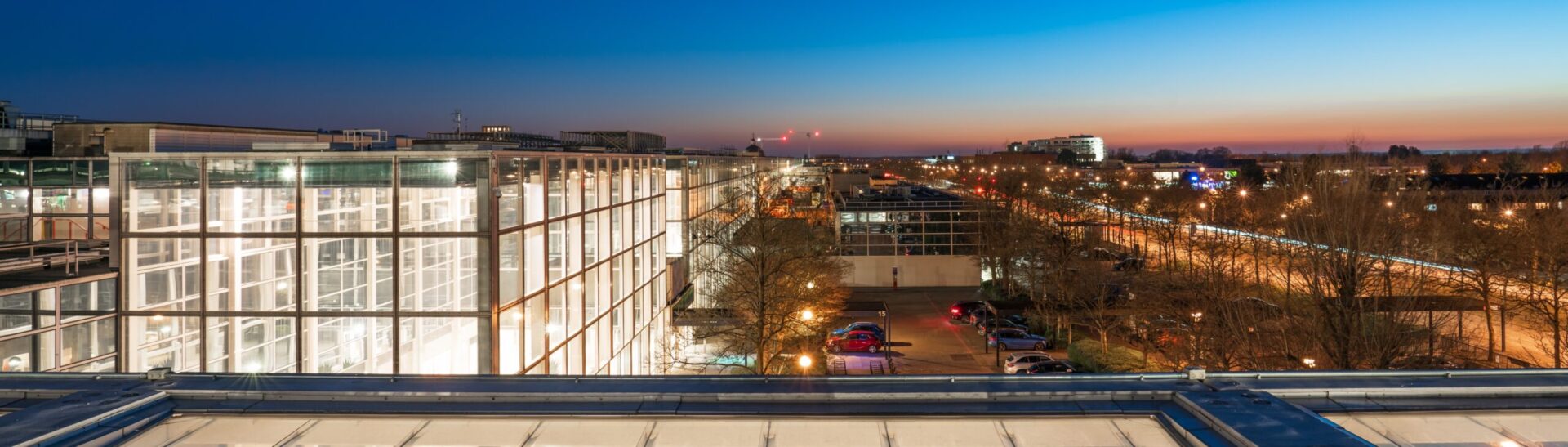
Architect Christopher Woodward designed the MK Shopping Building, an indoor mall in the heart of the city centre, as the high street. Opened in 1979, its natural lighting makes shopping a more pleasant experience than in most other indoor centres. The light comes from high clerestories over the malls, since the main roof is also the service yard for the shops, accessed by vehicles from a bridge that carries one of Milton Keynes’s many boulevards right over the middle of the building. The hi-tech design makes this unusual solution look deceptively simple.
Woodward had been appalled by the dingy, yet expensive basement servicing required by contemporary shopping centres at Brent Cross and Runcorn, and in the US. For this focal point of the new town, he wanted to create real streets, with a building line and open-air parking. The rooftop service yard fitted this model perfectly.
The building’s clean lines were emphasised by an external cladding of mirror glass, still novel in 1974 when the design was finalised.
8. Innovating in building design, materials and sustainability
MKDC promoted the Homeworld 81 exhibition, held near our offices in Bradwell Common in May 1981. This showcased “the latest developments in housing from international designers, architects and builders”. Thirty-six homes were built, ranging from studios to five-bedroom homes, and all still stand today.
Developers from countries including Britain, Canada, Denmark, Sweden and New Zealand were invited to take a plot and build the house design of their dreams. They included The Pyramid house, The Glass house, The House with no nails, The House where the roof is also the walls, The Flexible house, The Clipper house and The Computerised house.
Much of the focus was on energy saving and ideas that are commonplace now, such as solar panels, which were thought to be revolutionary at the time. There was also an emphasis on quick build, with developers proving that a home could go up in a matter of weeks.
The exhibits could either be demolished or sold after the exhibition – but none were demolished. During the exhibition’s opening month of May alone, more than 150,000 people paid to visit.
This was followed 5 years later by Energy World, a demonstration project of 51 low-energy houses constructed in the Shenley Lodge area of Milton Keynes, located even nearer to our offices. The project culminated in a public exhibition in August and October 1986 that attracted international interest. It was a significant landmark in the design and construction of low-energy housing, and in the development of energy efficiency evaluation tools. It has had a long-term impact on government policy and within the national house-building industry. The houses were designed to be at least 30% more efficient than the Building Regulations then in force.
9. A focus on both safety and speed
Road safety was deemed very important. In the shopping and commercial centre with a lot of activity 24/7, all the highway assets had to perform – both for motorists and pedestrians. Junctions, sight lines, marking, direction signals – all that regulatory equipment needed to be carefully integrated. The planners recognised how traditional towns and cities had become choked in traffic. The solution? Out of the centre they established a ‘relaxed’ grid of distributor roads about 1 kilometre apart, leaving the spaces in between to develop roads and communities more organically; all connected by roundabouts that allowed the smooth flow of traffic. This meant traffic movements are fast, with relatively little congestion since there are alternative routes to any particular destination. This precise grid spacing was also carefully chosen so that people would always be within six minutes’ walking distance of a grid-road bus-stop. An extensive network of shared paths for leisure cyclists and pedestrians called redways criss-crosses through and between them, designed to allow safe and car-free passage.
The radical grid plan was inspired by the work of Melvin M. Webber. Webber thought that telecommunications and mass automotive mobility meant that the old idea of a city as a concentric cluster was out of date and that cities which enabled people to travel around them readily would be the thing of the future, achieving “community without propinquity” for residents.
In recent years, the City Council has promoted MK as a testbed for experimental urban technologies. The most well-known of these is the Starship Technologies’ (largely) autonomous delivery robots: Milton Keynes provided its world-first urban deployment of these units in 2018. By October 2020, according to Starship, Milton Keynes had the ‘world’s largest autonomous robot fleet’. Other transport innovation projects include the LUTZ Pathfinder pod, an autonomous (self-driving) vehicle built by the Transport Systems Catapult.
10. Understanding of the importance of music and culture
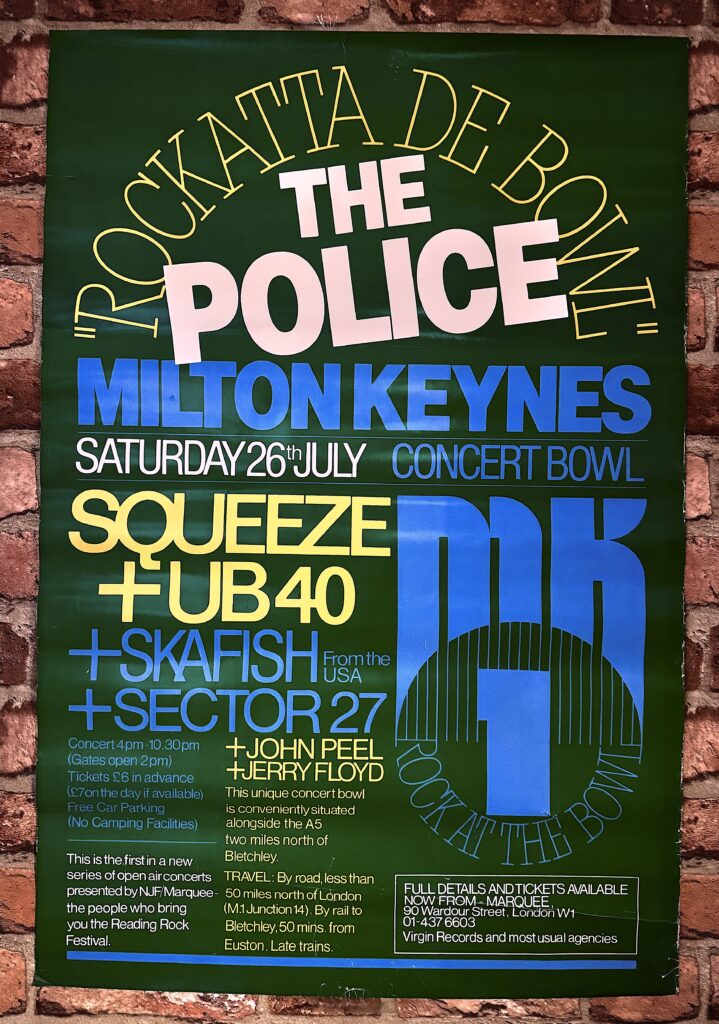
As part of its masterplan to create a vibrant city the MKDC designed a purpose-built bowl-shaped venue, based on the idea of the Hollywood Bowl, to house 65,000 concerts goers. The site was a former clay pit (for brickmaking), filled in and raised to form an amphitheatre using sub-soil excavated by the many new developments in the area. After debuting in 1979 with Soul at the Bowl, the Corporation turned to Harold and Barbara Pendleton, the founders of the Marquee club, Reading Festival and Entec (Chameleon’s sister production company) to promote 1980s “Rockatta De Bowl”.
This saw the Police kick off the venue as a major rock destination. 1982 saw Thin Lizzy headline and then a historic Genesis reunion concert titled “Six of the Best”. This laid the path that saw Queen, Status Quo, Michael Jackson, Robbie Williams, Metallica, Oasis, Take That, Foo Fighters, Green Day, Bon Jovi, U2 and David Bowie follow. As the son of Harold and Barbara, those historic first gigs were our chairman’s first experiences of Milton Keynes as a blossoming new town.
Modern and positive, with design and innovation at its heart, easy to access and with deep roots – that’s why we love Milton Keynes and why, we hope, our customers love us.
If you’ve made it this far, we hope you have learnt something new about our pioneering home city and how it inspires our approach. If you missed it our first blog shares the first 5 inspirational attributes we strive to represent, grouped under the theme “achieving success by planning and design”.